
PCF projects
Bauhaus of the Seas Sails
The Bauhaus of the Sea Sails project, funded by the European Union (Horizon Europe), addresses environmental challenges by mobilizing cities close to water. Running from 2022 to 2025, the project collaborates with seven cities (Venice, Hamburg, Lisbon, Oeiras, Malmö, Genova, and Rotterdam), a border park (Grenspark Groot Saeftinghe), universities, and cultural organizations to test new solutions for reviving the relationship between coastal communities and water. The overall aim is to achieve a sustainable and inclusive transition, keeping aesthetics at the center and working with communities. Our partners in each city are implementing innovative activities called “drops” to adapt to sea level rise (Future Tidal Architectures), raise citizens’ awareness of water and marine life (Ocean Literacy), and share cooking skills and recipes that benefit both people and nature (Regenerative Menu), to list but a few of our initiatives.


Multi-Functional Quay Walls
The much-needed rebuilding of Amsterdam’s decaying quay walls and bridges reveals the complexities of renewing heritage infrastructure in a UNESCO World Heritage city. Climate pressures such as sea-level rise, salinization and extreme weather further complicate this renewal. A KIEM grant entitled Amsterdam Time Travel awarded in 2021 provided the foundation for history and heritage-based analysis of bridges and quay walls. This work supports the systematic understanding and inventorying of historical datasets and included a case study of Amsterdam’s underground (Kremer, Scheffers, & Geven, 2023).
Water Discovery Lab @Le Havre Port Center
The Water Discovery Lab made its first journey outside the Netherlands, hosted by the Port Center of Le Havre. This interactive exhibition reinterpreted insights from the Rhine River to explore the past, present, and future of the Seine, focusing on governance, environmental challenges, and sustainable development. Through discussions led by Greta Delsalle, Camille Leroy, and Bénédicte Dufour, visitors examined the complexities of water governance, the vulnerabilities of port infrastructures on former marshlands, and adaptive strategies for the future. The program featured a playthrough of the Water Values serious game, engaging professionals and the public in real-world water management scenarios, alongside an interactive mapping exercise for younger visitors.


Sea-ing Africa
Tracing Legacies and Engaging Future Promises of ‘Big’ Infrastructure Projects in Port City Territories in Ghana and Morocco
With a focus on Ghana and Morocco, the project 'Sea-ing Africa' investigates the prominent place of infrastructure in the thinking about development in Africa. Infrastructure projects such as ports, highways and railways are intertwined with geopolitics, economic systems, political interests and cultural values that affect citizens. What are the relationships between large-scale processes of project planning and the local circumstances in which infrastructures are put in place? What is the societal impact of infrastructure as physical structure, design intervention and future making project?
Mapping Port City Territories x Nieuwe Instituut
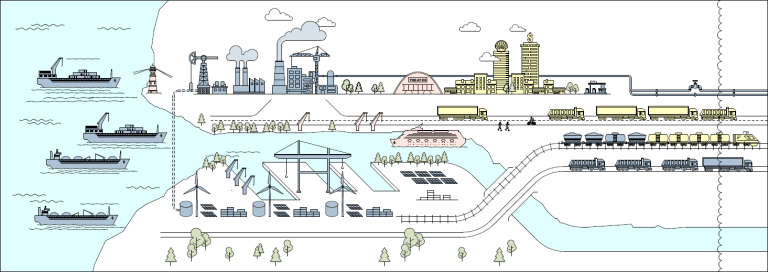
A multitude of port cities dots Europe’s coastline, all serving the purpose of facilitating maritime transportation. Over millennia, public and private leaders have built harbours, urban spaces and infrastructures in diverse territories to serve hinterlands, including landlocked capital cities and metropolitan areas. As nodes on the edge of water and land, port city territories embody knowledge on maritime flows and water conditions. At a time of climate change, they can be paradigms and stewards of sustainable development.
Taking a comprehensive, mapping based approach, Port City Atlas visualizes 100 port city territories located on four seas and connected through shared waters. It provides a foundation for comparative analysis beyond case study approaches that are often locked into national contexts, select languages or disciplinary approaches. Conceived as a work of reference, the book makes the case for a sea-based approach to the understanding and design of Europe.